

This month, we're sharing our W.E. Bradshaw University Innovation Grant winners, standing up for stronger protections for animals, and inviting you to help schools move away from animal use in science education.

NZAVS meets with Green MP Steve Abel
Last month, our Executive Officer, Jade Pengelly, had the privilege of meeting withGreen Party MP, Steve Abel at Parliament to discuss how we can move towards ending animal experimentation in Aotearoa, and focus on Non-Animal Methods in NZ research.
Jade discussed our W.E Bradshaw Grant with Steve, and explained how our two grant recipients are replacing the use of animals in research.
As a long-time advocate for environmental and animal welfare causes,Steve was a natural ally to bring this conversation to, and the meeting was a positive step forward. Jade & Steve talked through the gaps in current New Zealand legislation, the remarkable advances in cell-based and other alternative testing methods, and how other countries around the world have committed to ending animal experimentation through roadmaps.
We would like to thank Steve for taking the time to discuss our important advocacy work, and for having such an open conversation around next steps.
Stay tuned for more exciting updates in this area.
Dissection Survey
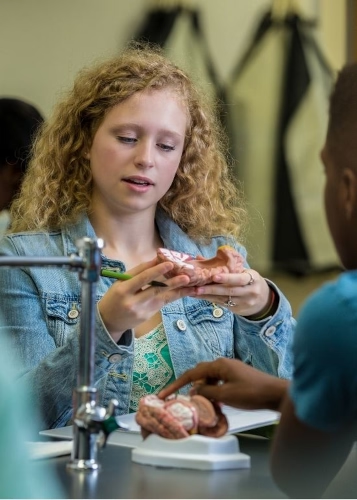
In April, NZAVS reached out to New Zealand schools to assess how widely animal dissection is still being used in education. Of the schools that responded, 42.5% reported using dissections, all of them High Schools or Composite schools. Notably, almost all had made no changes to their programme since our last survey in 2021, suggesting that without active support and intervention, little is changing on its own.
The other 57.5% did not use dissections in any way and were Primary Schools, Intermediate or Contributing. Although the use of animal parts (like cow eyes, plucks or hearts) dominated, there was still dissection of whole rats, rabbits, fish, and foetal pigs.
We asked the schools how their opt-out policies worked and found that most of them could do better by making the non-animal alternative truly equal, instead of sending students to the library with a worksheet or simply to a different class.
Several schools have animal use policies in place, but we received only responses of the opt-out policies being informal. However, we found that theanimal use policies do not cover dissections and are mainly covering the basic needs of classroom pets.

We are happy to share that some schools took up our offer to send them material on the scientific research surrounding dissections, which shows that it can lead to negative feelings and exclude students from a productive learning environment, while non-animal methods are consistently showing equal or better learning outcomes.
The dissecting schools saw the main barriers to stopping dissections is the lack of alternatives and proper funding.
We would like to thank the schools that took part for their time and honesty. The responses help us better understand how animals are currently being used in education across Aotearoa, and ensure that Kind Education is targeted where it is needed most.
Kind Education
Over the course of this year we have reimagined this campaign from the ground up, shifting from raising awareness to directly supporting schools to make the switch. That means grants, in-person visits, and hands-on help getting the right resources into classrooms.
As part of this new approach, NZAVS is offering two Kind Education Grants of up to $5,000 to schools accepted into our 2026 pilot, to fund their transition away from animal use. From virtual dissection software to anatomical models and teaching guides, these grants are designed to remove the practical barriers that have held schools back.
If you know a teacher, department head, or school that might be ready to take this step, we would appreciate your help spreading the word.
W. E. Bradshaw Grant - Advancing Animal-Free Science
We’re thrilled to celebrate one of our most significant milestones this year...the very first recipient of the W.E. Bradshaw University Innovation Grant!
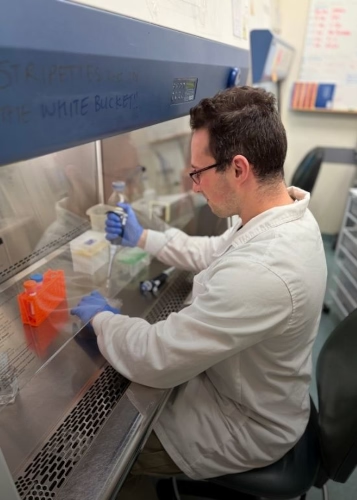
Thanks to the extraordinary generosity of our supporter, Mr Bradshaw, this new grant is helping accelerate a future where animal-free, human relevant research is the norm. The $50,000 grant has been awarded to Dr Indranil Basak at Victoria University of Wellington, whose project replaces animal testing entirely with human cells.
WINNER:
Dr Basak’s project focuses on Parkinson’s disease, the second most common neurodegenerative condition, expected to rise in Aotearoa as the population ages. There is no cure, and animal models have not translated well into effective treatments. Using skin cells from Pasifika patients who more often carry a genetic variant linked to early onset Parkinson’s, the cells are reprogrammed into brain cells and grown into 'mini-brains in a dish', or organoids.
These living human organoids let researchers compare healthy and disease affected cells, study different genetic forms, and test ways to repair damage.
This creates a more accurate, human relevant way to study Parkinson’s and test therapies, while replacing animal use with more reliable results.
The innovation shown across the applications was really encouraging and made it clear that there is strong momentum behind more ethical, animal-free research in Aotearoa.
- Sam La Hood, NZAVS Board Chair
RUNNER-UP:
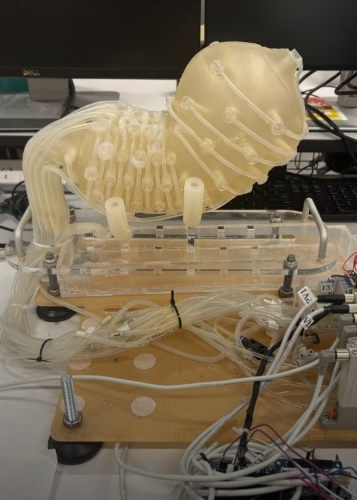
As this year’s runner-up, NZAVS is pleased to highlight a $10,000 contribution from Pathfinder supporting the University of Auckland’s development of a ‘smart’ gastric pacemaker.
Using a silicon stomach model and digital simulations, the project seeks to improve treatment options for gastroparesis while saving animals. With further funding, the system could support pacemakers that respond to patients’ needs in real time.
Industry News

The economic case for ending animal testing in the UK
The UK is showing what is possible when the government and science industry get behind the replacement of animal testing.
On 17th June, the animal-free cosmetics company Lush hosted an event at the UK Parliament to launch a major new report, commissioned by Lush and written by researchers at Northumbria University.
The report makes the case that replacing animal testing with non-animal New
Approach Methodologies (NAMs) doesn't just produce better, more reliable science, but could also save the UK significant money, by cutting the costs of slow, animal-based testing and opening up new jobs and investment in the growing NAMs industry instead.
It was launched at a parliamentary event at Westminster and shared directly with supportive MPs, with the hope of turning the UK governments 2025 roadmap strategy into action.
The report recommends several headline actions, including:
- Increase public funding for NAMs companies, research bodies, and research university groups.
- Support skills development specifically for organisations and researched receiving public NAMs funding.
- Set a legally binding date for a full ban on animal testing.
With New Zealand still relying on outdated animal testing methods in many areas of science, this report is a timely reminder that the shift towards NAMs isn't just saving animals but is also an economic opportunity we can't afford to miss out on. Read more about the report here!

Make your voice official at our upcoming AGM
Become an NZAVS member
Our upcoming Annual General Meeting (AGM) is shaping up to be very exciting. We have a brilliant guest speaker who is at the forefront of compassion and change for animals. Their story will inspire us all. Details are coming soon...
If you want to be there to stand alongside a community of like-minded animal champions and vote on our next big steps, including electing our Board members, now is the perfect time to apply to be an official NZAVS member.
If you have any questions, please reply to this email.
Ready to join? Apply to become an NZAVS member here.
Make your donation go further - at no cost to you!
In New Zealand, you can claim 33.33% of your donations back as a tax credit from Inland Revenue, and you can even claim for donations made up to four years ago.
If you choose to regift your tax credit back to NZAVS, you will be turning one act of generosity into two and helping us advocate for animals while accelerating progress toward ending harmful animal experimentation.
How to claim your tax credit
It's simple to do online through Inland Revenue:
- Log in to your myIR account (or create one using your IRD number).
- Select "Donation tax credit" from your account homepage. Our charity registration number is CC58881
- Click "Add a receipt" and enter NZAVS as the organisation.
- Upload your donation receipt (PDF, photo, or scan).
- Submit your claim.
If you need any help claiming your tax credit or choosing to gift it through IRD, please get in touch with us.

MyGivingCircle
We have an opportunity to secure a grant through MyGivingCircle, but we can’t do it without you.
MyGivingCircle awards grants to charities based on public votes, meaning you decide where finding goes. Thanks to our incredible community, NZAVS has won grants in the past, showing how small actions can add up to meaningful support. Every vote or donation helps.
Get your friends to vote for The New Zealand Anti-Vivisection Society as well.
Please share with your friends and ask them to vote for The New Zealand Anti-Vivisection Society as well. The more votes, the more chances to win!
Thank you!
Thank you for being part of the NZAVS community and standing with us to end the harmful use of animals in science. Your engagement and support help strengthen our advocacy, education, and push for humane, scientifically valid alternatives across Aotearoa.
If you're able to support our work further, a donation today will help us continue advancing our ability to fund ethical alternatives and holding decision‑makers to account. Every contribution strengthens our ability to create lasting change for animals.
We look forward to sharing more updates with you soon.


